Home
Archives
Quotable
2008
Samuel Hazo The Necessary Brevity of Pleasure William Butler Yates The Second Coming Lawrence Ferlinghetti i am waiting Allison Pearson Wife of the Year Spit Sir Elliot Husband of the Year David P Barash Want a Man or a Worm? Various On Travel & Travelers Bombay Striving & Sinking Anand Girdharadas Gregory David Gregory Shantaram William Matthews Misgivings Lopate It's Good We See Each Other Only AE Housman When The Eye of Day is Shut Robert Graves Among Thieves
The Necessary Brevity of PleasuresProlonged, they slacken into pain
or sadness in accordance with the law
of apples.
One apple satisfies.
Two apples cloy.
Three apples
glut.
Call it a tug-of-war between enough and more
than enough, between sufficiency
and greed, between the stay-at-homers
and globe-trotting see-the-worlders.
Like lovers seeking heaven in excess,
the hopelessly insatiable forget
how passion sharpens appetites
that gross indulgence numbs.
Result?
The haves have not
what all the have-nots have
since much of having is the need
to have.
Even my dog
knows that - and more than that.
He slumbers in a moon of sunlight,
scratches his twitches and itches
in measure, savors every bite
of grub with equal gratitude
and stays determinedly in place
unless what's suddenly exciting
happens.
Viewing mere change
as threatening, he relishes a few
undoubtable and proven pleasures
to enjoy each day in sequence
and with canine moderation.
They're there for him in waiting,
and he never wears them out.
Samuel Hazo,
from A Flight to Elsewhere.
Heaven is not reached at a single bound
But we build the ladder by which we rise
From the lowly earth to the vaulted skies,
And we mount to its summit round by round.
-- J Gilbert Holland - 1819
THE SECOND COMING

Turning and turning in the widening gyre
The falcon cannot hear the falconer;
Things fall apart; the centre cannot hold;
Mere anarchy is loosed upon the world,
The blood-dimmed tide is loosed, and everywhere
The ceremony of innocence is drowned;
The best lack all conviction, while the worst
Are full of passionate intensity.Surely some revelation is at hand;
Surely the Second Coming is at hand.
The Second Coming! Hardly are those words out
When a vast image out of Spiritus Mundi
Troubles my sight: a waste of desert sand;
A shape with lion body and the head of a man,
A gaze blank and pitiless as the sun,
Is moving its slow thighs, while all about it
Wind shadows of the indignant desert birds.
The darkness drops again but now I know
That twenty centuries of stony sleep
Were vexed to nightmare by a rocking cradle,
And what rough beast, its hour come round at last,
Slouches towards Bethlehem to be born?--William Butler Yates
I am WaitingI am waiting for my case to come up and I am waiting for a rebirth of wonder and I am waiting for someone to really discover America and wail and I am waiting for the discovery Of a new symbolic western frontier and I am waiting for the American Eagle to really spread its wings and straighten up and fly right and I am waiting for the Age of Anxiety to drop dead and I am waiting for the war to be fought which will make the world safe for anarchy and I am waiting for the final withering away of all governments and I am perpetually awaiting a rebirth of wonder I am waiting for the second coming And I am waiting For a religious revival To sweep thru the state of Arizona And I am waiting For the grapes of wrath to be stored And I am waiting For them to prove That God is really American And I am waiting To see God on television Piped into church altars If they can find The right channel To tune it in on And I am waiting for the last supper to be served again and a strange new appetizer and I am perpetually awaiting a rebirth of wonder I am waiting for my number to be called and I am waiting for the Salvation Army to take over and I am waiting for the meek to be blessed and inherit the earth without taxes and I am waiting for forests and animals to reclaim the earth as theirs and I am waiting for a way to be devised to destroy all nationalisms without killing anybody and I am waiting for linnets and planets to fall like rain and I am waiting for lovers and weepers to lie down together again in a new rebirth of wonder I am waiting for the great divide to be crossed and I anxiously waiting For the secret of eternal life to be discovered By an obscure practitioner and I am waiting for the storms of life to be over and I am waiting to set sail for happiness and I am waiting for a reconstructed Mayflower to reach America with its picture story and TV rights sold in advance to the natives and I am waiting for the lost music to sound again in the Lost Continent in a new rebirth of wonder I am waiting for the day that maketh all things clear and I am waiting for retribution for what America did to Tom Sawyer and I am waiting for the American Boy to take off Beauty's clothes and get on top of her and I am waiting for Alice in Wonderland to retransmit to me her total dream of innocence and I am waiting for Childe Roland to come to the final darkest tower and I am waiting for Aphrodite to grow live arms at a final disarmament conference in a new rebirth of wonder I am waiting to get some intimations of immortality by recollecting my early childhood and I am waiting for the green mornings to come again for some strains of unpremeditated art to shake my typewriter and I am waiting to write the great indelible poem and I am waiting for the last long rapture and I am perpetually waiting for the fleeting lovers on the Grecian Urn to catch each other at last and embrace and I am awaiting perpetually and forever a renaissance of wonder ---Lawrence Ferlinghetti
Husbands and wives
With children between them
Sit in the subway
So I have seen them
One word only from station to station
So much talk for so close a relation.[See Also: The Divorce]
Wife of the Year
(Reporting From Cape Town, Allison Pearson)
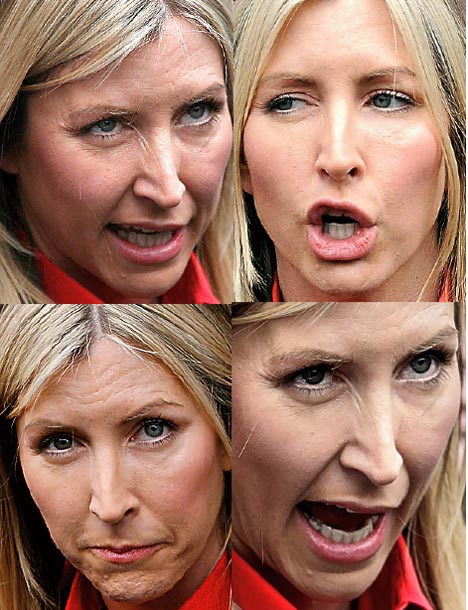
Unstoppable as the Duracell bunny, gobbier than Sharon Osbourne, enjoying the same firm grasp on reality as Mohamed Al Fayed and with more issues than Reader's Digest, Heather Mills finally announced her divorce settlement of £24.3million with all the shy grace and modesty which we have come to expect of Lady McCartney
The poor coppers on duty behind the ranting Heather started to nod off.
On the roof of nearby St Paul's Cathedral, pigeons slipped into a coma and fell to their deaths as Heather began her 97th sentence without drawing breath.
On and on she moaned. Who says you can't turn sour grapes into whine?Paul McCartney had just parted with almost 25 million quid to be shot of this woman.
Worth every penny, Paul, love.
You know what they say: Marry in haste, repent at heather.Mills is comically oblivious to how she comes across.
In some compartment of that mad fantasist's brain, she honestly believes she is the big-hearted "Campaigning Girl" raking in alimony to hand it over "to me charities".
To the rest of us she is the worst kind of Nouveau Celeb - gauche, greedy, self-obsessed and constantly carping about the media while taking out a 999-year lease on the limelight.
Even the judge had to conclude that Ms Mills's evidence was, ahem, "less than candid."
How did Heather think it would go down when she moaned that the £35,000-a-year allocated to her daughter would not be enough to fly Beatrice 'A-Class'?
Puts that little crisis in Darfur into perspective, doesn't it, pet?
Millions are starving but, for Lady Mucca, hardship is a four-year-old rock princess roughing it in Business.
Besides, thirty-five grand sounds plenty to me.
Enough for a few party frocks and the rest to go on a therapist when the poor kid is old enough to realise what sort of mother she's been landed with.
Heather may have bagged herself a title, but she never did acquire any class. Chucking water over Fiona Shackleton, Paul's solicitor, was cheap.
It was also cheap to bitch about the ex-Beatle's "low offer of 15.8" (that's millions, in case you were wondering).
Heather had set her sights on a jawdropping £125 million for an exhausting four years of marriage.
Normally, I am the first person to insist that a divorced wife gets an equal share of the cake. But Heather Mills made a mockery of marriage. She was only two weeks away from her wedding to film-maker Chris Terrill when she announced she was getting together with Paul.
The love for this multi-millionaire was so powerful that, overnight, Lancashire hotpot-loving Heather discovered she had been a vegan all along!
Heather is brilliant at faking it. She could be anything a man wanted her to be. And she saw that what widower Paul wanted her to be was Linda.
No wonder Stella McCartney hated her. Talk about the Wicked Stepmother.
Heather may accuse Fiona Shackleton of behaving in "the worst manner you could imagine". But it is Heather who is an embarrassment to her sex.
Frankly, I have more respect for Ashley Dupré, who provided escort services to disgraced New York governor Eliot Spitzer for $1,000 an hour. At least Ashley made her price clear up front and never claimed to be doing it for charity.
As the old joke goes: A gold-digger married the guy for money.
She divorced him for the same reason.
Now, who does that sound like?
--Allison Pearson
And Speaking of Elliott-I wanna-wife-2-Spitzer hear this:
The Governor's House / Trained Man
Husband of the Year:
And did we say, A House Trained Man? From The Capitol StepsWant a shrew or a worm? Beware: The "whisper" within every man:
On Monagomy:
Want a man, or a worm?
Among mammals, expecting monogamy tends to run against the grain of nature.As an evolutionary biologist, I look at New York Gov. Eliot Spitzer's now-public sexual indiscretions and feel justified in saying, "I told you so."
One of the most startling discoveries of the last 15 years has been the extent of sexual infidelity (scientists call it "extra-pair copulations" or EPCs) among animals long thought to be monogamous. It's clear that social monogamy -- physical association and child rearing between a male and a female -- and sexual monogamy are very different things. The former is common; the latter is rare.
At one point in the movie "Heartburn," Nora Ephron's barely fictionalized account of her marriage to reporter Carl Bernstein, the heroine tearfully tells her father about her husband's infidelities, only to be advised, "You want monogamy? Marry a swan." Yet thanks to DNA evidence, we know now that even those famously loyal swans aren't sexually monogamous.
One species that is, and, significantly, perhaps the only one that could be reliably designated as such, is Diplozöon paradoxum, a parasitic worm that inhabits the intestines of fish. Among these animals, male and female pair up while adolescents; their bodies literally fuse together, whereupon they remain sexually faithful until death does not them part.
One of the most important insights of modern evolutionary biology has been an enhanced understanding of male-female differences, deriving especially from the production of sperm versus eggs. Because sperm are produced in vast numbers, with little if any required parental follow-through, males of most species are aggressive sexual adventurers, inclined to engage in sex with multiple partners when they can. Males who succeed in doing so leave more descendants.
A story is told in New Zealand about the early 19th century visit of an Episcopal bishop to an isolated Maori village. As everyone was about to retire after an evening of high-spirited feasting and dancing, the village headman -- wanting to show sincere hospitality to his honored guest -- called out, "A woman for the bishop." Seeing a scowl of disapproval on the prelate's face, the host roared even louder, "Two women for the bishop!"
On balance, the Maori headman had an acute understanding of men. He also reflected a powerful cross-cultural universal: Around the world, high-ranking men have long enjoyed sexual access to comparatively large numbers of women, typically young and attractive. Moreover, women have by and large found such men appealing beyond what may be predicted from their immediate physical traits. "Power," wrote Henry Kissinger, "is the ultimate aphrodisiac."
Power-as-pheromone is pretty much the default among mammals. Elk, elephant seal, baboon or chimpanzee, in a wide array of species, females eagerly mate with dominant males while disdaining subordinates. And they do so, more or less, in harems.
Not surprisingly, before the homogenization of cultures that resulted from Western colonialism, more than 85% of human societies unabashedly favored polygamy. In such societies, men who accumulate power, wealth and status gain additional wives and consorts. In avowedly monogamous cultures, successful males accumulate a wife and often additional girlfriends. Even if, thanks to birth control technology, they do not actually reproduce as a result (and thus enhance their evolutionary "fitness"), they are responding to the biological pressures that whisper within men.
Part of being successful, moreover, is a tendency to feel entitled and often to be uninhibited -- in part because one outcome of our species-wide polygamous history is that successful men have been those who took risks, which paid off. The losers were mostly found among the unsuccessful bachelors who, by definition, did not contribute very much to succeeding generations of men, or to their inclinations.
All of which contributes to the apparent sex appeal of such less-than-stunning physical specimens as Kissinger, Woody Allen and Bill Clinton, not to mention the persistence of sex scandals among the popular and powerful across the political and ideological spectrum, including Thomas Jefferson, JFK, Hugh Grant, Newt Gingrich, Larry Craig and a long list, receding almost to the infinite past as well as likely into the indefinite future. For men at the top -- rock stars, successful athletes, politicians, wealthy CEOs, the jet-set glitterati -- such opportunities are exceedingly numerous, not so much because they have insatiable sex drives but because they are dominant males in a biologically randy species.
Some readers may bridle at this characterization of Homo sapiens as EPC-inclined, but the evidence is overwhelming. That doesn't justify adultery, by either sex, especially because human beings -- even those burdened by a Y chromosome and suffering from testosterone poisoning -- are presumed capable of exercising control over their impulses. Especially if, via wedding vows, they have promised to do so. After all, "doing what comes naturally" is what nonhuman animals do. People, most of us like to think, have the unique capacity to act contrary to their biologically given inclinations. Maybe, in fact, it is what makes us human.
But even a smidgen of evolutionary insight suggests that maleness plus money plus political power isn't likely to add up to the kind of sexual restraint that the public expects. A concluding word, therefore, to the outraged voters of New York state: You want monogamy? Elect a swan. Or better yet, a Diplozöon paradoxum.
David P. Barash, an evolutionary biologist, is professor of psychology at the University of Washington.
nnnnnnnnnnnnnnnnnnnnnnnUUUUUUUUUUUUUUUUUUUUUUUUUUUUUUUUUUUUUUUUUUUUUUUnnnnnnnnnnnnnnnnnnn

|
On Travel and Travelers
|
|
|
| When a man opens the car door for his
wife, it’s either a new car or a new wife. Prince Phillip, Duke of Edinburgh, 1921
^^^^^^^^^^^^^^^^^^^^^^^^^^^^^^^^^^^^^^^^^^^^^^^^^^^^^^^^^^^^
The heart of marriage is memories.
|
Walking In The Air
LYRICS
We're walking in the air
We're floating in the moonlit sky
The people far below are sleeping as we fly
We're holding very tight
I'm riding in the midnight blue
I'm finding I can fly so high above with you
Far across the world
The villages go by like dreams
The rivers and the hills
The forest and the streams
Children gaze open mouthed
Taken by surprise
Nobody down below believes their eyes
We're surfing in the air
We're swimming in the frozen sky
We're drifting over icy
mountains floating by
Suddenly swooping low on an ocean deep
Arousing of a mighty monster from its sleep
We're walking in the air
We're dancing in the midnight sky
And everyone who sees us greets us as we fly
ON THE OCCASION OF BIRTHDAYS ALL AROUND
|
"Women, when they have made a sheep of a man, always tell him that he is a lion with a will of iron. --Balzac, 1799
Marriage is a wonderful invention; but then again so is a bicycle repair kit. --Billy Connolly, 1976
They laughed when I said I was going to be a comedian.  They're not laughing now.
                                            --Bob Monkhouse, comedian (1928-2003)
It's Good We Only See Each Other
|
People who live entirely by the fertility of their own
imaginations are fascinating,
brilliant and often charming, but they should be
sat next to at dinner parties, not lived with.
Scottie Fitzgerald
 |
|
 |
 |
When the eye of day is shut, |
|
|
|
|
|
|
|
Among Thieves Lovers in the act
dispense To the act again they go Lovers,
the conclusion is
|